
You bought your home. The inspector said the roof was in good shape. The shingles are rated for 30 years. You haven’t had a single leak. Then you go to renew your homeowners insurance — or you call us to shop your policy — and we have to deliver news you weren’t expecting: your roof is 18 years old and half the carriers on our market won’t touch it.
This conversation happens in our office almost every week. And almost every time, the homeowner says the same thing: “But they’re 30-year shingles.”
We understand the frustration. It feels arbitrary. It feels unfair. But once you understand what’s actually happening to that roof while you’re living under it — and what the insurance industry has learned from billions of dollars in coastal claims — the carrier requirements start to make a lot more sense.
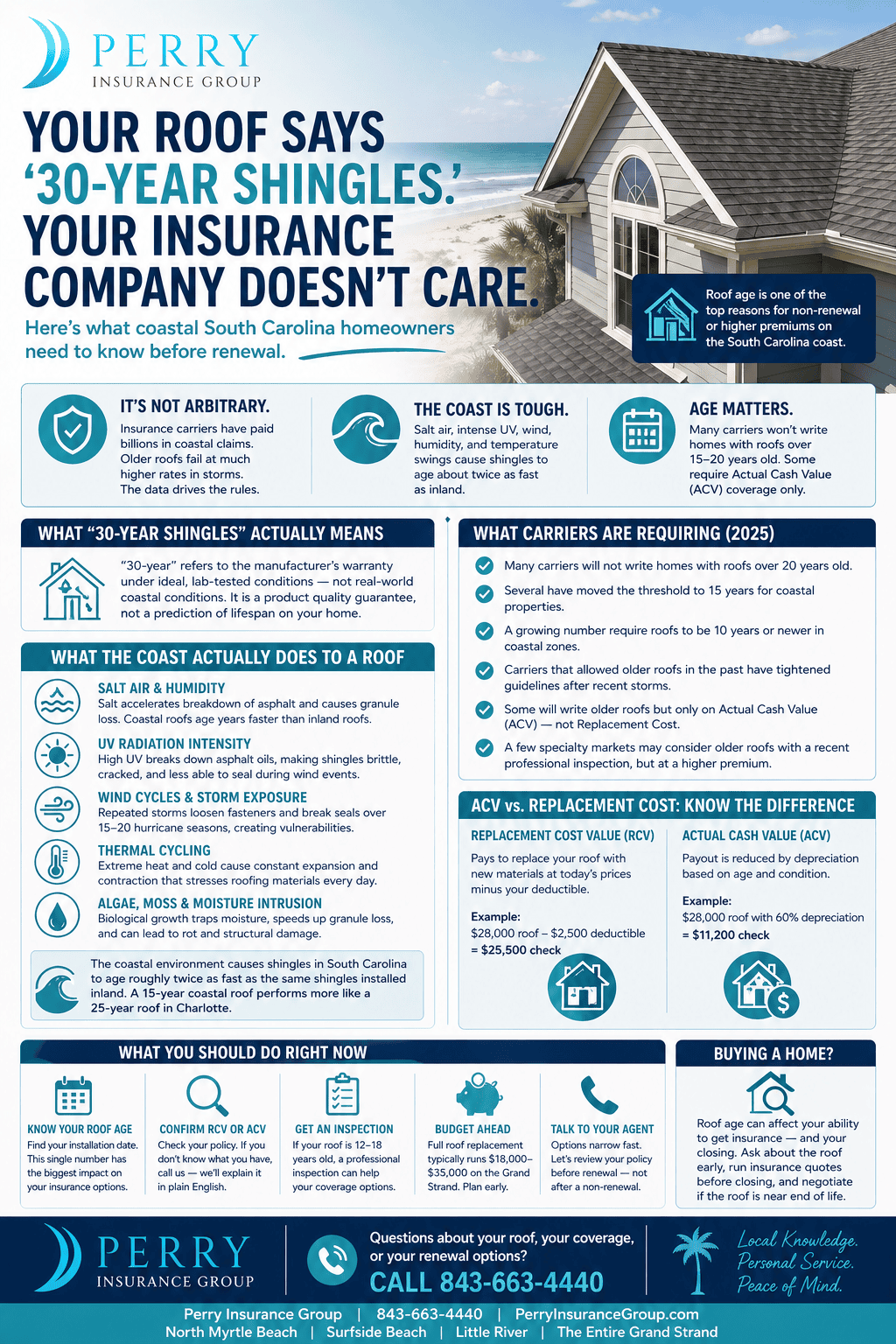
What “30-Year Shingles” Actually Means
The “30-year” label on architectural shingles refers to the manufacturer’s warranty period — the length of time the manufacturer guarantees the product against defects under controlled conditions. Those conditions are tested in a lab. They are not tested on a house in North Myrtle Beach, South Carolina, sitting a mile from the Atlantic Ocean.
The warranty rating is based on an idealized installation in a temperate inland climate with moderate UV exposure, normal rainfall, and no sustained salt air. It has nothing to do with how long the shingles will actually perform on a coastal South Carolina home.
A 30-year shingle warranty is a manufacturing quality guarantee — not a prediction of how long the roof will last in your specific environment.
What the Coast Actually Does to a Roof
If you’ve lived on or near the Grand Strand for any length of time, you already know that the environment here is hard on everything — cars, decks, paint, and especially roofs. Here is what is working against your shingles every single day:
Salt Air and Humidity
Persistent salt air accelerates the breakdown of the asphalt binders that hold shingles together and causes granule loss — the tiny protective particles embedded in the surface of every shingle. Once granule loss begins, the underlying asphalt is exposed to direct UV radiation, and deterioration accelerates rapidly. Homes within a few miles of the ocean see this process happen years faster than inland homes. In some cases, a coastal roof that is 12 years old will show the same level of granule loss and surface degradation as a 20-year-old roof in the Piedmont.
UV Radiation Intensity
South Carolina sits at a latitude that delivers high-intensity UV radiation year-round. UV degrades asphalt shingles by breaking down the oils that keep them pliable and flexible. As those oils evaporate, shingles become brittle, begin to crack along their edges, and lose the ability to seal tightly against adjacent shingles. A shingle that flexes and seals properly during a wind event when it is brand new becomes a shingle that cracks, lifts, or breaks when it has been baking in the Carolina sun for 15 years. The performance difference between a new shingle and a 15-year coastal shingle during a Category 1 event is not marginal — it is significant.
Wind Cycles and Storm Exposure
Every named storm, tropical system, and nor’easter that moves through the Carolinas creates wind cycles that stress shingle fasteners and seals. Even storms that do not make direct landfall send sustained winds, pressure fluctuations, and driving rain that work at the adhesive strips and fasteners on every shingle. Over 15 to 20 hurricane seasons, those repeated cycles loosen fasteners, break seals, and leave microscopic vulnerabilities that compound with each subsequent event. Carriers have decades of post-storm inspection data showing that older coastal roofs account for a disproportionate share of total losses — not because the storm was worse, but because the roof was weaker going into it.
Thermal Cycling
The Grand Strand experiences a temperature range that creates constant expansion and contraction in roofing materials across the seasons. Rooftop surface temperatures in July can exceed 160 degrees Fahrenheit. Winter cold snaps drop those same surfaces to near freezing. This thermal cycling stresses every fastener, seal, and shingle tab repeatedly over the life of the roof — the same physical process that eventually cracks concrete and splits wood, working more slowly but just as surely on asphalt shingles. After 15 to 20 years of thermal cycling on a South Carolina coast home, the cumulative stress on roofing materials is substantial.
Algae, Moss, and Moisture Intrusion
High humidity and year-round warmth create near-ideal conditions for algae, moss, and lichen growth on roof surfaces. Beyond the cosmetic problem, biological growth retains moisture directly against the shingle surface, accelerating granule loss and creating pathways for water to infiltrate under shingles and into the roof decking. Once moisture reaches the decking, you are dealing with rot, mold, and potential structural compromise — well ahead of any warranty timeline and well ahead of any visible sign of a problem from the ground or inside the home.
The combination of salt air, intense UV, repeated wind cycles, thermal stress, and persistent humidity means coastal shingles in South Carolina age at roughly twice the rate of the same product installed inland. A 15-year coastal roof in North Myrtle Beach is performing more like a 25-year roof in Charlotte.
What the Insurance Industry Has Learned
Insurance carriers have paid tens of billions of dollars in coastal claims over the past two decades — through Hurricanes Floyd, Isabel, Charley, Ivan, Wilma, Ike, Sandy, Florence, Dorian, and Isaias, among others. They have enormous data sets on which homes sustained the most damage, which claims were the largest, and what those homes had in common.
The single most consistent finding across carrier underwriting research: older roofs fail during storm events at dramatically higher rates than newer roofs, and the relationship between roof age and claim frequency is significantly steeper in coastal environments than inland ones.
A 20-year-old architectural shingle roof in Charlotte may still be performing adequately. A 20-year-old architectural shingle roof in North Myrtle Beach has absorbed 20 hurricane seasons, roughly 7,300 days of salt air and high UV exposure, hundreds of thermal expansion cycles, and multiple direct wind events. The claims data reflects exactly what the physics would predict — and carriers have adjusted their underwriting guidelines accordingly.
This is not arbitrary. It is the insurance market pricing risk based on what it has actually observed, repeatedly, at scale, over decades.
What Carriers Are Requiring Right Now
Here is what we are seeing across the markets we work with for coastal South Carolina properties, as of 2025:
● Many standard homeowners carriers will not write new policies on homes with roofs over 20 years old — full stop, regardless of condition.
● Several carriers have moved their threshold to 15 years for coastal properties within a defined distance of the ocean or Intracoastal Waterway.
● A growing number of carriers have tightened to 10 years for properties east of Highway 17 or within a specific coastal zone designation.
● Some carriers that were writing 15 and 20-year roofs three or four years ago have since tightened their guidelines following recent storm seasons — clients who were fine at renewal last year may not be fine at renewal this year.
● Carriers will sometimes write a home with an older roof but only on an Actual Cash Value basis rather than Replacement Cost — which changes the economics of a claim significantly (more on this below).
● A small number of specialty markets will consider older roofs with current professional inspection documentation, but at substantially higher premium.
The practical effect for Grand Strand homeowners: if your roof is approaching 15 years and you are in a coastal zone, your renewal options are already narrowing. At 18 to 20 years, you may be looking at non-renewal notices, significantly higher premiums, or a shift to ACV coverage without realizing it.
The ACV vs. Replacement Cost Problem
This distinction deserves its own section because it is where clients get hurt the most — and understand it the least until after they file a claim.
Replacement Cost Value (RCV) means that if a covered loss damages your roof, your insurance pays what it costs to replace the roof with new materials at today’s prices, minus your deductible. If your roof costs $28,000 to replace and your deductible is $2,500, you receive a check for $25,500.
Actual Cash Value (ACV) means your claim payment is reduced by depreciation calculated from the age and condition of the roof at the time of loss. On a roof that is 18 to 20 years old, that depreciation factor can run 50 to 70 percent. That same $28,000 roof replacement might yield an ACV check for $8,400 to $14,000 — leaving you $14,000 to $19,600 out of pocket to cover the actual cost of the work.
Many homeowners do not know their roof is on ACV coverage until they file a claim. By then, the policy has already been written and there is nothing to be done about it. The time to ask is before you renew, not after the storm.
If your carrier has shifted your roof to ACV coverage — either proactively or because you moved markets — your effective financial protection on the largest single structural component of your home has been cut dramatically. This is something we review specifically with every client, and it is something you should confirm with your current agent by name before your next renewal.
What You Should Do Right Now
If you own a home on the South Carolina coast, here is the practical action plan based on what we advise our own clients:
Know the exact age of your roof
If you do not know precisely when it was last replaced, pull your closing documents, prior home inspection reports, or permit records from your county. A roofer can also assess approximate age during an inspection. This single number has more impact on your insurance options than almost any other factor about your home.
Confirm whether your roof is on RCV or ACV coverage
This is written into your policy — either in the declarations page or the policy conditions section. If you cannot find it or do not understand what you are reading, call us. We will tell you exactly what you have and what it means for a real claim.
Get a professional inspection if you are between 12 and 18 years
A documented professional inspection showing current condition can support continued coverage with certain carriers and can give you an honest assessment of how much useful life remains. It will not override hard age cutoffs, but it is useful information for both your insurance positioning and your financial planning.
Start budgeting for replacement before the market forces your hand
A full roof replacement on a coastal Grand Strand home typically runs between $18,000 and $35,000 depending on size, pitch, material, and current labor and material costs. If your roof is 12 to 14 years old, you are in the planning window. Start getting estimates now. Replacing a roof proactively on your own timeline is a very different financial experience than replacing it reactively because a carrier non-renewed you and your remaining options require it.
Talk to your agent before your renewal notice arrives
If a carrier sends you a non-renewal notice over roof age, your options are not gone — but they narrow considerably under time pressure. We have markets for difficult risks and experience finding solutions before situations become emergencies. We cannot do as much once a non-renewal is already in motion and a deadline is bearing down.
A Final Note on What This Means for Home Buyers
If you are purchasing a home on the South Carolina coast, roof age should be one of the first things you ask about — before you are under contract if possible, and certainly before you close. We have seen transactions complicated significantly because a buyer got to closing week and discovered that the roof was 19 years old and the carriers their agent had quoted were no longer willing to write the policy.
Ask the seller for documentation of the roof installation date. Ask your insurance agent to run the markets before you remove contingencies. If the roof is near or past the threshold, factor a replacement into your negotiation. A $20,000 to $25,000 credit or seller concession for a roof replacement is a legitimate and increasingly common part of coastal South Carolina real estate transactions.
The Bottom Line
The “30-year shingle” label was never a promise about how long your roof would last on the South Carolina coast. It was a manufacturer’s warranty written for average conditions in average climates — and the Grand Strand is not an average climate for roofing materials. It is one of the most demanding environments in the country.
Insurance carriers have learned this through hard experience over multiple storm seasons, and their underwriting guidelines now reflect it with age requirements that can feel surprising or even punitive if you don’t know the reasoning behind them. Understanding why the requirements exist won’t make a roof replacement cheaper, but it will help you plan for it before it becomes a crisis.
If you have questions about how your roof age is affecting your current coverage, whether you’re on RCV or ACV, or what your options look like going forward, call us. This is exactly the kind of conversation we have every week, and we would rather have it with you while there is still time to plan than after a storm has already made the decision for everyone.
Perry Insurance Group | 843-663-4440 | PerryInsuranceGroup.com North Myrtle Beach | Surfside Beach | Little River | The Entire Grand Strand


