If you own a home near the South Carolina coast — or anywhere near a body of water in Horry, Georgetown, or Brunswick County — you have probably heard the term “elevation certificate” at some point. Maybe your lender mentioned it. Maybe someone told you it could lower your flood insurance premium. Maybe you have no idea what it is or whether you need one.
Here is a plain-language explanation of what an elevation certificate is, what it is used for, and whether it is worth getting one for your property.
What an Elevation Certificate Is
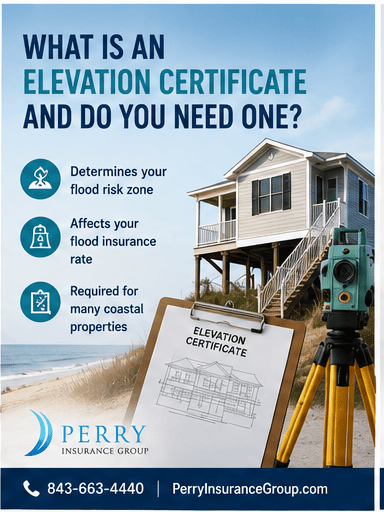
An elevation certificate (EC) is an official document prepared by a licensed surveyor or engineer that records the elevation of your home relative to the Base Flood Elevation (BFE) established by FEMA for your area. The BFE is the elevation that floodwaters are estimated to reach during a 100-year flood event in your specific flood zone.
The certificate documents your home’s exact position relative to that flood threshold. Those measurements drive both your FEMA flood zone designation and, in many cases, your flood insurance premium.
What It Is Used For
Flood insurance pricing: Under FEMA’s National Flood Insurance Program (NFIP), an elevation certificate is one of the primary inputs for calculating your flood insurance premium. A home with a first floor that sits two feet above the BFE is statistically less likely to flood than a home whose first floor sits at or below BFE. Under FEMA’s updated Risk Rating 2.0 methodology (implemented in 2021), the role of the elevation certificate is somewhat reduced, but elevation certificates remain relevant for many properties and are still used by private flood carriers.
Private flood insurance quoting: Private flood carriers — which often offer better pricing than the NFIP, particularly for elevated homes — rely heavily on elevation certificates to assess and price risk. Having a current elevation certificate in hand can significantly streamline the quoting process.
FEMA flood zone appeals: If your home has been placed in a high-risk flood zone (Zone AE, VE, or similar) but your elevation certificate shows your lowest floor is well above the BFE, you may be eligible to apply for a Letter of Map Amendment (LOMA) from FEMA. A successful LOMA can remove your property from the high-risk zone designation entirely, which can eliminate a mandatory flood insurance requirement and reduce your premium substantially.
Real estate transactions: In coastal South Carolina real estate, elevation certificates are common transaction documents. Buyers in flood zones often request them during due diligence.
Do You Need One?
Not every homeowner needs an elevation certificate. Here is a practical guide:
If you own a home in a FEMA Special Flood Hazard Area (Zone A, AE, AO, VE, or similar) and your lender requires flood insurance, an elevation certificate may be needed to accurately determine your NFIP rate or support a LOMA application.
If you are paying high NFIP flood insurance premiums and your home appears well-elevated above the BFE, getting an elevation certificate could document your actual elevation and potentially reduce your premium significantly.
If you are shopping private flood insurance, having a current elevation certificate will help carriers price your risk accurately and may give you access to better rates.
If you are paying more than $1,500 per year for NFIP flood insurance on a home that appears well-elevated, the cost of an elevation certificate — typically $500 to $800 — may pay for itself in the first year of premium savings.
How to Get One
Elevation certificates must be prepared by a licensed land surveyor, engineer, or architect. The cost typically ranges from $400 to $900. Before commissioning a new survey, check whether one already exists for your property — sometimes on file with your local floodplain administrator, county GIS office, or mortgage lender.
If you are unsure whether an elevation certificate would help you, call us. We work with flood insurance markets daily and can quickly assess whether your current premium suggests you might benefit.
Perry Insurance Group | 843-663-4440 | PerryInsuranceGroup.com | North Myrtle Beach | Surfside Beach | Little River | The Entire Grand Strand


